For example:
- 15 minutes = 0.25 hours
- 30 minutes = 0.50 hours
- 45 minutes = 0.75 hours
- 60 minutes = 1.00 hour
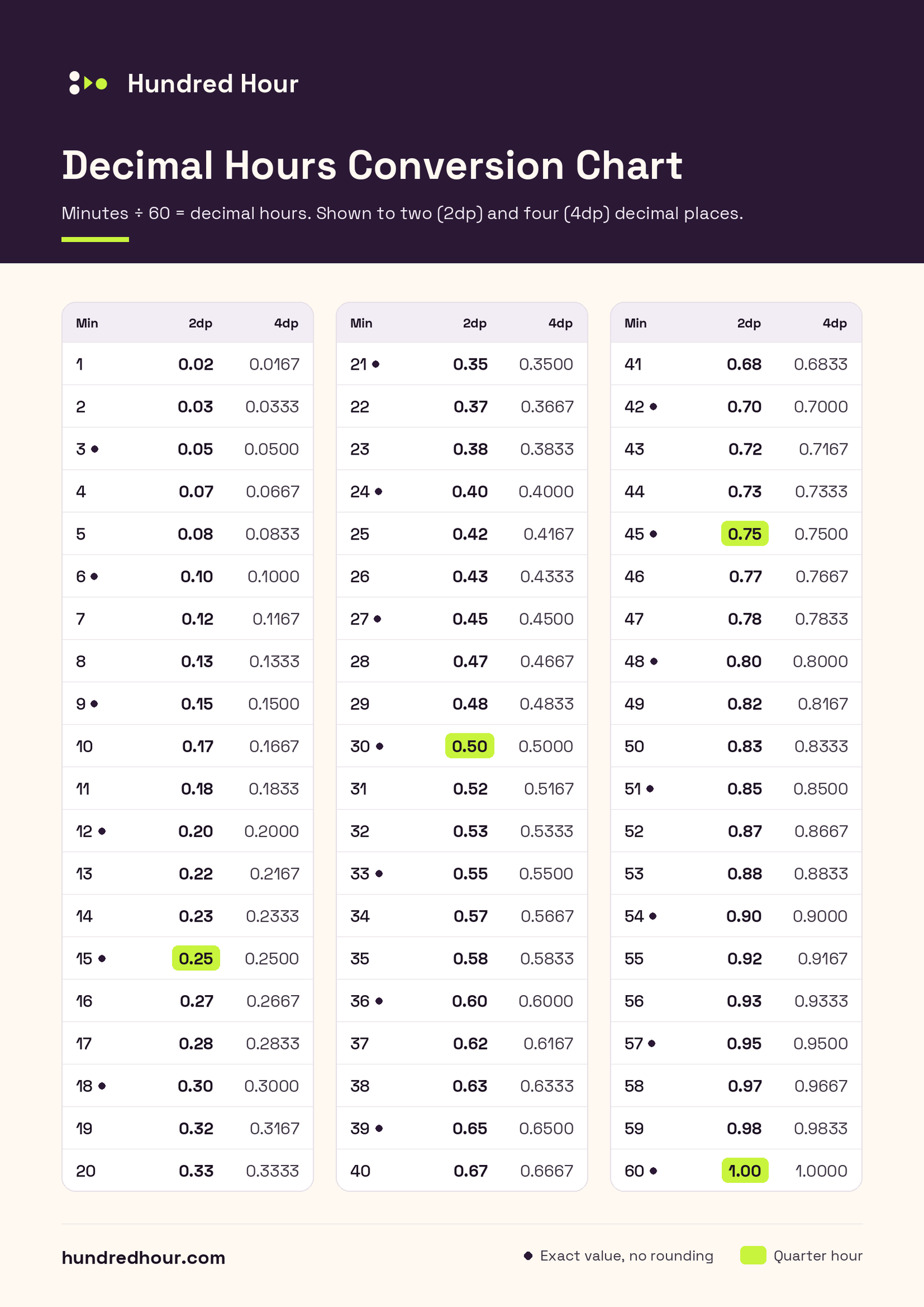
Minutes to decimal hours chart
The table below shows every minute from 1 to 60 as decimal hours.
The two-decimal column is useful for quick reference. The four-decimal column gives a more precise value where the conversion does not divide evenly.
| Minutes | Hours (2dp) | Hours (4dp) |
|---|
| 1 | 0.02 | 0.0167 |
| 2 | 0.03 | 0.0333 |
| 3 | 0.05 | 0.0500 |
| 4 | 0.07 | 0.0667 |
| 5 | 0.08 | 0.0833 |
| 6 | 0.10 | 0.1000 |
| 7 | 0.12 | 0.1167 |
| 8 | 0.13 | 0.1333 |
| 9 | 0.15 | 0.1500 |
| 10 | 0.17 | 0.1667 |
| 11 | 0.18 | 0.1833 |
| 12 | 0.20 | 0.2000 |
| 13 | 0.22 | 0.2167 |
| 14 | 0.23 | 0.2333 |
| 15 | 0.25 | 0.2500 |
| 16 | 0.27 | 0.2667 |
| 17 | 0.28 | 0.2833 |
| 18 | 0.30 | 0.3000 |
| 19 | 0.32 | 0.3167 |
| 20 | 0.33 | 0.3333 |
| 21 | 0.35 | 0.3500 |
| 22 | 0.37 | 0.3667 |
| 23 | 0.38 | 0.3833 |
| 24 | 0.40 | 0.4000 |
| 25 | 0.42 | 0.4167 |
| 26 | 0.43 | 0.4333 |
| 27 | 0.45 | 0.4500 |
| 28 | 0.47 | 0.4667 |
| 29 | 0.48 | 0.4833 |
| 30 | 0.50 | 0.5000 |
| Minutes | Hours (2dp) | Hours (4dp) |
|---|
| 31 | 0.52 | 0.5167 |
| 32 | 0.53 | 0.5333 |
| 33 | 0.55 | 0.5500 |
| 34 | 0.57 | 0.5667 |
| 35 | 0.58 | 0.5833 |
| 36 | 0.60 | 0.6000 |
| 37 | 0.62 | 0.6167 |
| 38 | 0.63 | 0.6333 |
| 39 | 0.65 | 0.6500 |
| 40 | 0.67 | 0.6667 |
| 41 | 0.68 | 0.6833 |
| 42 | 0.70 | 0.7000 |
| 43 | 0.72 | 0.7167 |
| 44 | 0.73 | 0.7333 |
| 45 | 0.75 | 0.7500 |
| 46 | 0.77 | 0.7667 |
| 47 | 0.78 | 0.7833 |
| 48 | 0.80 | 0.8000 |
| 49 | 0.82 | 0.8167 |
| 50 | 0.83 | 0.8333 |
| 51 | 0.85 | 0.8500 |
| 52 | 0.87 | 0.8667 |
| 53 | 0.88 | 0.8833 |
| 54 | 0.90 | 0.9000 |
| 55 | 0.92 | 0.9167 |
| 56 | 0.93 | 0.9333 |
| 57 | 0.95 | 0.9500 |
| 58 | 0.97 | 0.9667 |
| 59 | 0.98 | 0.9833 |
| 60 | 1.00 | 1.0000 |
Some minute values produce repeating decimals. These values have been rounded in the table.
Your payroll, timesheet or workforce system may use its own number of decimal places or rounding rules, so check the requirements of the system you are using where exact recorded time matters.
Download the decimal hours conversion chart
If you use decimal hours regularly, you may find it easier to keep a copy of the chart.
Download the Hundred Hour decimal conversion chart and keep it available for timesheets, payroll calculations or working-hour checks.
Download PDF Chart
The PDF version is designed for printing or keeping as a quick desktop reference.
Download Image Chart
The image version is useful for saving to a phone, tablet or computer for quick access.
You can also bookmark this page if you prefer to always use the latest online version.
Bookmark this page for quick conversions
If you regularly complete timesheets or check decimal hours, save this page in your browser bookmarks or favourites.
That gives you quick access to the full 1–60 minute chart whenever you need it.
If you need to convert a complete time rather than look up a single minute value, use the Hundred Hour Time Converter instead.
How to use the chart with whole hours
If your time contains whole hours as well as minutes, keep the whole hours and use the chart to convert only the minutes.
For example:
8 hours 27 minutes
Find 27 minutes in the chart: 27 minutes = 0.45 hours
Keep the 8 whole hours:
8h 27m = 8.45 decimal hours
Another example:
7 hours 42 minutes
42 minutes = 0.70 hours
So: 7h 42m = 7.70 decimal hours
The same method works for any combination of hours and minutes.
Don’t confuse minutes with decimal hundredths
One of the most common mistakes with decimal hours is treating the digits after the decimal point as though they are minutes.
For example: 30 minutes is not 0.30 hours
An hour contains 60 minutes, so 30 minutes is half of an hour.
Half expressed as a decimal is 0.50.
Therefore: 30 minutes = 0.50 hours
By comparison:
0.30 × 60 = 18
So: 0.30 hours = 18 minutes
This is why 7:30 = 7.50 decimal hours, but 7.30 decimal hours = 7 hours 18 minutes.
A colon and a decimal point do not mean the same thing.
Why some decimal-hour values are rounded
Not every number of minutes divides neatly into 60.
For example:
20 ÷ 60 = 0.333333…
So 20 minutes = 0.333333… hours.
When shown to two decimal places, this becomes 0.33 hours. At four decimal places: 0.3333 hours.
Similarly:
50 ÷ 60 = 0.833333…
So 50 minutes may be shown as 0.83 hours, or more precisely 0.8333 hours.
The underlying time has not changed. Only the number of decimal places used to display it has changed.
Different payroll and workforce systems may have their own rounding rules.
How to calculate decimal hours yourself
You can convert any number of minutes into decimal hours using this formula:
Minutes ÷ 60 = decimal hours
For example:
45 ÷ 60 = 0.75
So: 45 minutes = 0.75 hours
For a full time such as 8 hours 45 minutes:
8 + 0.75 = 8.75 hours
For a more detailed explanation, see How to Convert Minutes to Decimal Hours.
Convert your own time
Need to convert more than a single minute value?
Use the Hundred Hour Time Converter to:
For example: 7h 42m → 7.70 hours or 7.70 hours → 7h 42m
Convert My Time