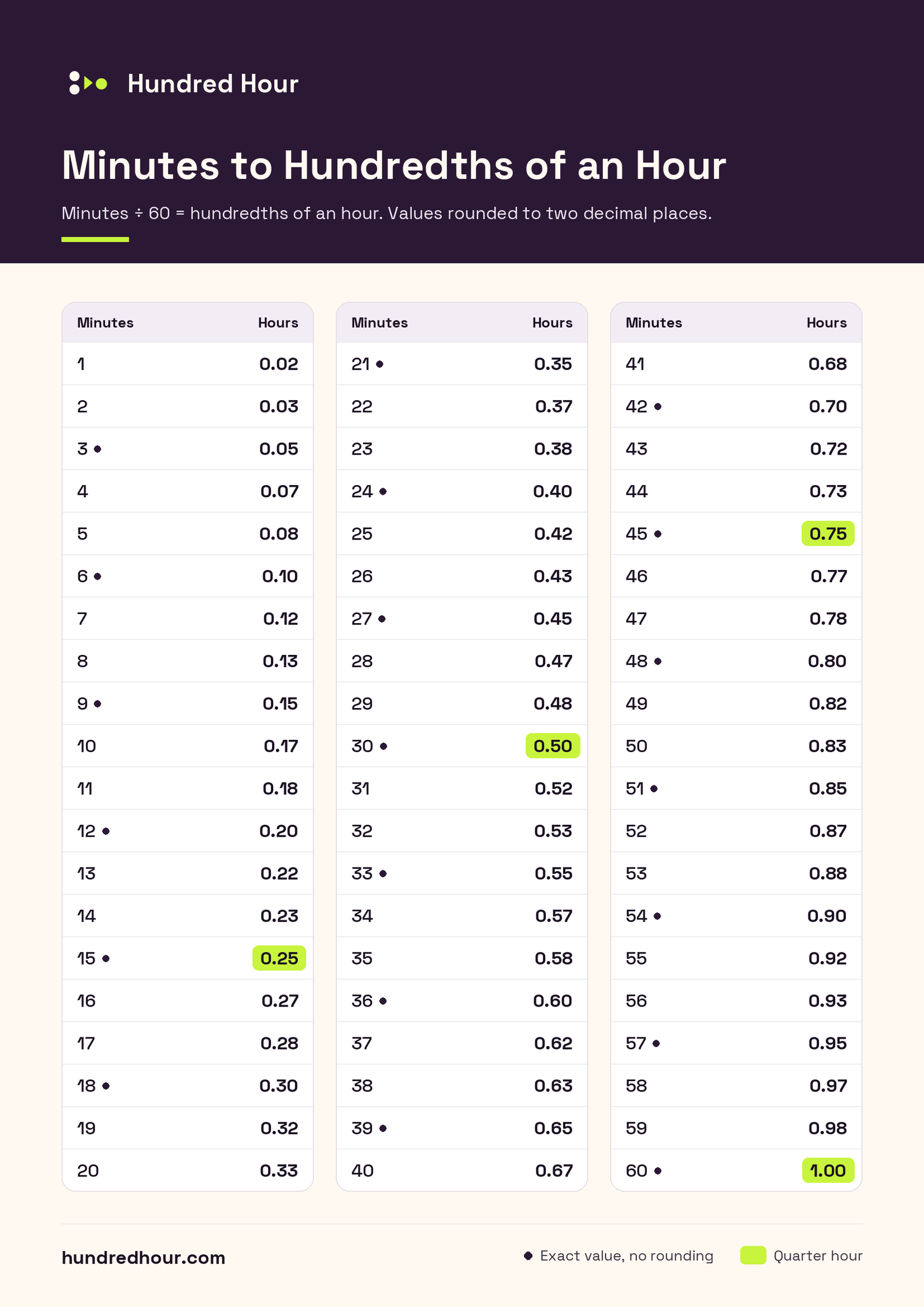
Quick examples:
- 6 minutes = 0.10
- 12 minutes = 0.20
- 15 minutes = 0.25
- 18 minutes = 0.30
- 30 minutes = 0.50
- 45 minutes = 0.75
- 60 minutes = 1.00
Minutes to hundredths of an hour chart
| Minutes | Hundredths |
|---|
| 1 | 0.02 |
| 2 | 0.03 |
| 3 | 0.05 |
| 4 | 0.07 |
| 5 | 0.08 |
| 6 | 0.10 |
| 7 | 0.12 |
| 8 | 0.13 |
| 9 | 0.15 |
| 10 | 0.17 |
| 11 | 0.18 |
| 12 | 0.20 |
| 13 | 0.22 |
| 14 | 0.23 |
| 15 | 0.25 |
| 16 | 0.27 |
| 17 | 0.28 |
| 18 | 0.30 |
| 19 | 0.32 |
| 20 | 0.33 |
| Minutes | Hundredths |
|---|
| 21 | 0.35 |
| 22 | 0.37 |
| 23 | 0.38 |
| 24 | 0.40 |
| 25 | 0.42 |
| 26 | 0.43 |
| 27 | 0.45 |
| 28 | 0.47 |
| 29 | 0.48 |
| 30 | 0.50 |
| 31 | 0.52 |
| 32 | 0.53 |
| 33 | 0.55 |
| 34 | 0.57 |
| 35 | 0.58 |
| 36 | 0.60 |
| 37 | 0.62 |
| 38 | 0.63 |
| 39 | 0.65 |
| 40 | 0.67 |
| Minutes | Hundredths |
|---|
| 41 | 0.68 |
| 42 | 0.70 |
| 43 | 0.72 |
| 44 | 0.73 |
| 45 | 0.75 |
| 46 | 0.77 |
| 47 | 0.78 |
| 48 | 0.80 |
| 49 | 0.82 |
| 50 | 0.83 |
| 51 | 0.85 |
| 52 | 0.87 |
| 53 | 0.88 |
| 54 | 0.90 |
| 55 | 0.92 |
| 56 | 0.93 |
| 57 | 0.95 |
| 58 | 0.97 |
| 59 | 0.98 |
| 60 | 1.00 |
Values are rounded to two decimal places where the exact decimal does not terminate.
For example, 20 minutes is exactly 0.3333… of an hour, so it is shown as 0.33 in a two-decimal chart.
Your payroll or timesheet system may use its own number of decimal places or rounding rules.
What is one hundredth of an hour?
One hundredth of an hour is 0.01 hour.
A normal hour contains 60 minutes, or 3,600 seconds.
So:
3,600 ÷ 100 = 36
Therefore: 0.01 hour = 36 seconds
This is an important distinction.
Hundredths of an hour do not mean that an hour has 100 normal minutes.
A standard hour still contains 60 minutes.
The “hundredths” simply refer to dividing the hour into 100 decimal parts.
Why some minute values need rounding
Some minute values divide neatly into a two-decimal number.
For example:
30 ÷ 60 = 0.50
So: 30 minutes = 0.50 hours
Other values produce a repeating decimal.
For example:
20 ÷ 60 = 0.333333…
Rounded to two decimal places: 20 minutes = 0.33 hours
Another example:
22 ÷ 60 = 0.366666…
Rounded to two decimal places: 22 minutes = 0.37 hours
The original time has not changed. Only the decimal representation has been rounded.
Exact conversions vs rounded conversions
Some minute values convert exactly into tenths or hundredths of an hour.
For example:
- 6 minutes = 0.10
- 12 minutes = 0.20
- 18 minutes = 0.30
- 24 minutes = 0.40
- 30 minutes = 0.50
- 36 minutes = 0.60
- 42 minutes = 0.70
- 48 minutes = 0.80
- 54 minutes = 0.90
- 60 minutes = 1.00
These values divide evenly into a 60-minute hour.
Other values, such as 20 or 22 minutes, produce repeating decimals and are rounded when displayed to two decimal places.
Hundredths of an hour vs payroll rounding
Converting minutes into hundredths of an hour is a mathematical calculation.
Payroll rounding is a separate process.
For example, 20 minutes converts mathematically to:
20 ÷ 60 = 0.3333… hours
When shown to two decimal places: 0.33 hours
An employer or payroll system may also have separate rules that round recorded clock times before payroll is calculated.
Those rules can vary.
So: minute-to-hundredths conversion and payroll rounding are not the same thing.
If you are entering time into a specific payroll or workforce system, check how that system expects time to be recorded.
Hundredths vs tenths of an hour
Hundredths and tenths are different.
0.01 hour is one hundredth of an hour. It equals 36 seconds.
0.10 hour is one tenth of an hour. It equals 6 minutes.
This distinction is particularly important because some billing systems use tenths of an hour, while payroll or timesheet systems may display time in hundredths.
For example:
- 6 minutes = 0.10 hour
- 36 seconds = 0.01 hour
How to use the chart with whole hours
If you have whole hours and minutes, keep the whole hours and convert only the minutes.
For example:
7 hours 22 minutes
Find 22 minutes in the chart: 22 minutes = 0.37 hours
So: 7h 22m ≈ 7.37 hours
The decimal value is rounded to two decimal places.
Another example:
8 hours 30 minutes
30 minutes = 0.50 hours
So: 8h 30m = 8.50 hours
This is why normal time such as 8:30 should not be entered as 8.30 when a system expects decimal hours.